2a Visualisation, Sensing, Devices and Immersion
The transformative potential of Virtual Worlds (VW) hinges critically upon significant advancements in Human Machine Interfaces (HMI) to create seamless and effective User Experiences (UX) across the continuously expanding range of professional and consumer Extended Reality (XR) applications. While direct view displays like smartphones have a role, our focus here is on near-to-eye 'virtual view' displays, such as head-mounted displays (HMDs), with future possibilities even extending to 'on-eye' devices or direct neural interfaces. HMDs—including advanced headsets and smart glasses—are essential to offering truly immersive modalities and are repeatedly identified as critical enablers across all use cases. Improving their performance, comfort, and sustainability is a central research and innovation priority to support the transition to VW. Also, multi-sensory applications are in scope. Defining the next generations of these physical interfaces for Virtual, Augmented, and Mixed Realities demands a holistic, transdisciplinary approach, encompassing technological innovation, user-centricity, ethical considerations, and sustainability. This hardware-oriented chapter envisions the research priorities needed to build a European industrial and technological roadmap for immersive technologies, with dual use capabilities (civil and defence applications). They are categorised into four foundational layers: Visualisation, Sensing, Devices, and Immersion.
Realising the full potential of these immersive experiences faces myriad integrated challenges. Fundamentally, devices must be user-centric, intuitive, and eventually adaptive or assistive, minimising learning curves and maximising accessibility for all users, including those with sensory impairments or disabilities, while rigorously addressing critical safety and health impacts, such as motion sickness and long-term visual health.
Concurrently, accurate sensing of the user's environment and behaviour is paramount for responsive and adaptive immersive systems. This requires sophisticated sensors and advanced AI to capture and interpret both explicit inputs (e.g., voice, gesture, facial expressions) and implicit cues (e.g., attention, intent, emotion), alongside contextual data. Effective data transmission and reception are vital to handle the increasing data volume, ensuring smooth and uninterrupted experiences. Within this data-rich environment, privacy and ethics compliance are fundamental, demanding robust protection of user data, transparency, and adherence to ethical guidelines to build trust and ensure regulatory approval.
From a hardware perspective, devices must be compact, wearable, and untethered to afford users mobility and comfort, requiring lightweight, ergonomic designs capable of autonomous operation. Crucially, energy consumption must be optimised as these wearables become more complex and resource-intensive, extending portable device usability and reducing environmental impact. A growing imperative is sustainability, focusing on creating recyclable, reparable hardware aligned with circular economy principles, and reducing reliance on critical materials.
Furthermore, AI integration is pivotal, enhancing immersive system capabilities from user interaction to system performance, demanding efficient computing power management for real-time rendering, sensing, and interaction. Multimodal interactions and multiuser utilisation are essential for fostering collaborative and social experiences, requiring sensing systems that can accommodate multiple users simultaneously and provide meaningful shared engagements with effective feedback mechanisms. Finally, achieving truly immersive, closer-to-reality experiences necessitates integrating all human senses, moving beyond visual stimuli to include auditory, haptic, olfactory, and gustatory feedback. This level of immersion, alongside robust interoperability across diverse platforms, devices, and applications, will ensure seamless, low-latency, and high-fidelity experiences vital for user satisfaction.
Addressing these interconnected global challenges is vital for advancing the development and adoption of immersive technologies. By strategically focusing on user-centric design, health and safety, hardware innovation, energy efficiency, sensory integration, interoperability, data management, privacy and ethics, sustainability, AI integration, and multimodal interactions, Europe can pave the way for a new generation of engaging, accessible, and sustainable immersive experiences.
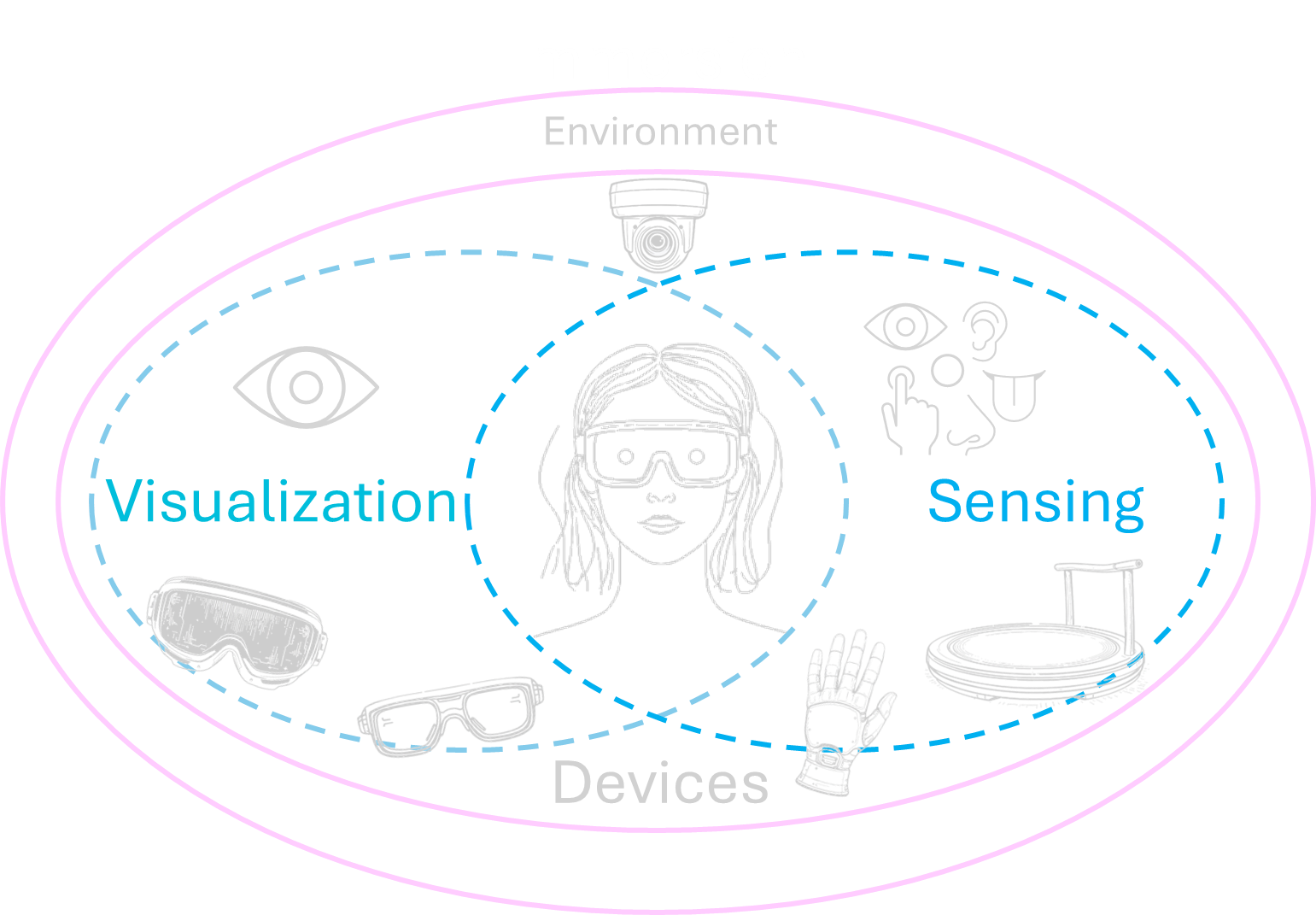
Research topics for visualisation, sensing and devices
This section explores the critical technology blocks required to develop immersive visualisation interfaces, advanced multimodal sensors and integrated wearable devices, detailing their significance, current challenges, and proposing strategic research and innovation objectives.
Visualisation: Realism in immersive experiences
Visualisation technologies are the primary interface in virtual, augmented, and mixed reality, fundamentally shaping user engagement and comfort. The core objective is to deliver realistic, perceptually coherent, and comfortable 3D experiences, necessitating advanced display systems. These systems must balance high fidelity, compact form factors, and low energy consumption, especially for wearable devices. Ensuring visual health (topic addressed in 3d Health Aspects Related to VW), safety, and adaptability to individual needs are also crucial. Strategic research in this domain underpins the sustainability and inclusiveness of future VW.
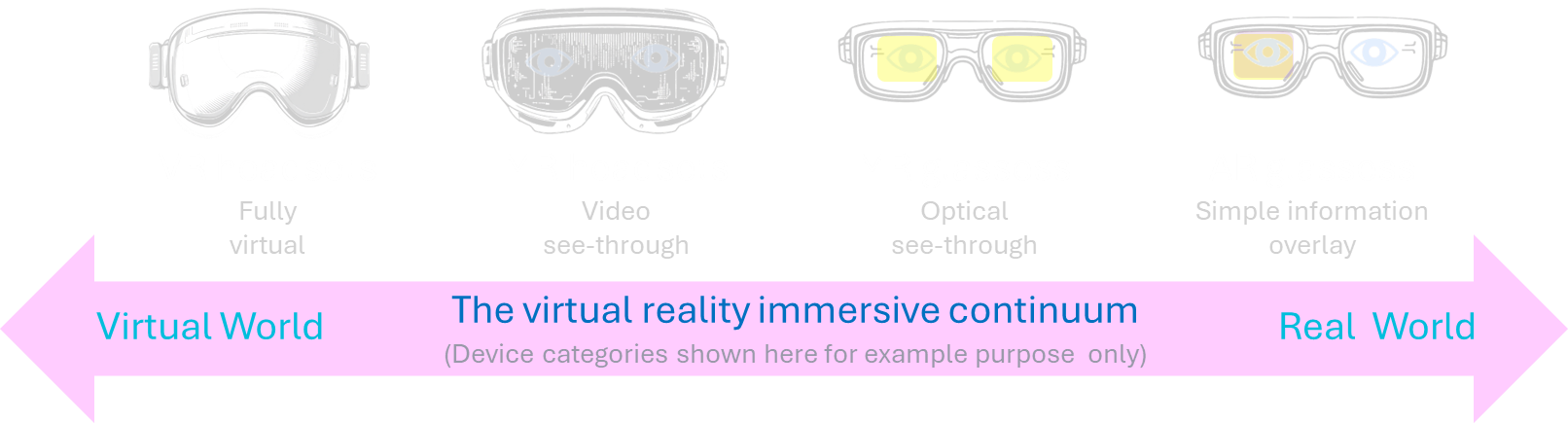
2a.1 High quality, low energy and safe images
Achieving full-colour, high-brightness, and high-resolution images with low energy consumption and a wide field of view is crucial for enhancing realism and ensuring visibility across various lighting conditions, particularly for AR. This aims to improve user immersion and peripheral awareness by minimising geometric aberrations. Additionally, low latency and fast response times are vital for reducing motion blur and simulator sickness, while comprehensive synchronisation mechanisms (e.g., Genlock, Vsync) are necessary to match framerates between diverse devices. Ensuring colour accuracy, uniformity, and dynamic range further supports naturalistic rendering, all while carefully managing brightness and guaranteeing eye safety for end users.
Problem Definition and Research Gap: For wearable devices, achieving these high-fidelity visual metrics is severely constrained by form factor and power budgets. Current Virtual Reality (VR) headsets suffer from insufficient angular resolution and restricted fields of view, especially in the bottom field for near vision, alongside nasal restrictions that hinder comfortable binocular fusion. Large temporal fields of view often introduce optical distortions. In optical see-through architectures, the low transfer efficiency of existing optical combiners necessitates very high-brightness displays. Furthermore, balancing resolution with frame rate in real-time image processing remains a significant challenge. Overall, substantial research efforts are needed to optimise performance and overcome practical design constraints.
Research and Innovation Objectives:
-
Develop and optimise display technologies such as Foveated displays, Micro-OLED, OLED-on silicon, and MicroLEDs to deliver high-quality, full-colour, real-time images with enhanced brightness and resolution, while achieving low energy consumption and compact light engines.
-
Address manufacturing challenges for emerging display technologies like MicroLEDs and overcome issues in Laser Beam Scanning (LBS) related to speckle, safety, eye box, and image uniformity, to enable compact and lightweight designs suitable for immersive applications.
-
Investigate and implement solutions such as local dimming for optical see-through Augmented Reality (AR) devices to improve contrast and develop transparent micro displays to eliminate the need for external optical combiners and exit pupil expansion, thereby enhancing overall system efficiency and UX.
2a.2 Optical components
Developing versatile and scalable fabrication technologies for novel optical components is crucial for achieving compact optical architectures without compromising visual quality or adding excessive weight to devices. This directly contributes to the miniaturisation of VR, AR and MR headsets, enabling greater ease of personalisation and significantly reducing manufacturing costs for industrial players. These advancements are essential for creating more aesthetically pleasing and comfortable wearable immersive technologies.
Problem Definition and Research Gap: The primary problem lies in the inherent bulkiness of traditional refractive optics, which severely limits the miniaturisation of XR headsets. Existing optical combiners utilising waveguides are often bulky, heavy, and non-aesthetic. Furthermore, folded optics suffer from significant optical inefficiencies, with light transmission frequently below 25%. Diffractive optical elements (DOEs) and holographic optical elements (HOEs) are promising but currently plagued by chromatic aberrations and limited efficiency, particularly in broadband or full-colour applications. While Meta optical elements (MOEs) or Metasurfaces offer potential, achieving broadband, full-colour performance with high efficiency remains a substantial technical challenge. Across DOE, HOE, and MOE technologies, industrial scalability is identified as a major bottleneck.
Research and Innovation Objectives:
-
Advance the development of flat optics, metasurfaces, diffractive optical elements, and waveguides, focusing on their maturity for use as optical combiners or integrated optics to enable compact and high-performance immersive devices.
-
Research and implement industrial processes for micro- and nanofabrication of DOEs and MOEs, including photolithography, nanoimprint, and 3D printing, to ensure scalability and cost effective production of these novel optical components.
-
Explore and utilise high refractive index materials with industrial processing means, which are essential for manufacturing flat optics or organic optical waveguides that can meet the stringent requirements for miniaturisation and visual quality in next-generation XR hardware.
2a.3 User centric 3D realistic visualisation
Providing realistic 3D visualisation that prioritises user comfort is critical for enhancing perceptual realism and depth cues in immersive experiences. Moreover, visualisation systems must accommodate individual visual needs, such as prescription correction, interpupillary distance (IPD) adjustment, and age or health-related vision changes. This includes also addressing common issues such as the vergence-accommodation conflict (VAC), which impacts cognitive performance, fatigue, and cyber sickness. Enabling a wide range of monocular and motion-based depth cues (e.g., motion parallax, occlusion, shading, focus blur) is essential for a natural experience. Furthermore, developing optical architectures that support aesthetic devices and user privacy (avoiding stray light), alongside facilitating natural and shared spatial understanding in collaborative environments, positions multi-perspective visualisation as a cornerstone for future immersive systems.
Problem Definition and Research Gap: A significant research gap exists across diverse immersive technologies (optical see-through, video see-through, VR, contact lenses, large screens) due to their varied requirements. Most current optical see-through AR devices are monocular with limited fields of view (20-30°), and existing wearable products poorly manage prescription needs, often relying on add-on lenses. Achieving effective 3D perception and seamless superposition between virtual images and the real environment is crucial but challenging, directly impacting the feeling of immersion. Managing cyber sickness (including VAC) and ensuring user comfort during prolonged wear (e.g., weight, eye strain) remain significant obstacles. While light field and holographic displays offer potential, they are currently prohibitively expensive and bulky for widespread deployment. Furthermore, robust multimodal orchestration is needed for integrating with interaction systems (gestural, vocal, spatial input) across multiple users, and there is a critical absence of a unified protocol or software layer to support cross device, cross-platform multi-perspective display technologies. Overall, this topic has very low technological maturity.
Research and Innovation Objectives:
-
Develop Spatial Light Modulators, Light Field displays, and holographic displays, alongside the use of dynamic optical layers (e.g., Liquid Crystals, metasurfaces) to modulate depth perception and mitigate vergence-accommodation conflict (VAC) based on gaze direction or object depth, requiring new optically active materials.
-
Explore and develop novel technologies and paradigms for real-time multipoint-of-view visualisation, including display systems combining directional optics, rear projection, and adaptive rendering for multi-user, headset-free 3D visualisation.
-
Implement real-time light field rendering with spatial foveation and neural interpolation for computational efficiency and integrate low latency multiview user tracking to drive dynamic scene recomposition tailored to each observer in collaborative immersive environments.
Sensing: Bridging physical and digital realities
Sensors are fundamental to interaction between the physical and digital worlds in XR, enabling seamless integration and immersion. While current sensing modalities exist, significant advancements are needed for miniaturisation, energy efficiency, and computational efficiency in wearable head-mounted devices. Multimodal sensing, leveraging techniques like sensor fusion, offers increased accuracy and resilience. A deeper understanding of user states—attention, cognition, emotion, and intent—is vital for frictionless, user-tailored interfaces. This necessitates user-specific, privacy-aware multi-modal sensing to realise optimal future XR experiences.
2a.4 Sensing framework for digital environment representations
To effectively augment reality, the physical world must first be accurately sensed and comprehended. It is crucial to minimise the latency between the physical reality and its digital representation, ensuring a real-time understanding of the user's environment. The process of generating this digital representation must also be highly energy-efficient to enable on-device processing close to the sensors, which is vital for the battery life and practicality of wearable devices. This capability is essential for application developers who require reliable and low-latency digital representations of the user's surroundings.
Problem Definition and Research Gap: A significant research gap lies in developing adaptive and resilient sensor fusion frameworks that can dynamically adjust to changing environmental conditions, providing reliable sensing in open-world scenarios and potentially learning from contextual cues to optimise performance. There is a need for energy-efficient, real-time digital representations of the user's surroundings, encompassing not just geometry but also material properties, semantics, and object interrelations. While current solutions for world representation, such as SLAM and spatial computing in devices like Meta Quest 3 and Apple Vision Pro, utilise various sensors (global shutter, 3D, inertial, microphones), further research and development are needed to improve sensor frameworks, data fusion, and processing for reliable, on-device, and efficient digital representations. Current adoption rates are low due to the high computational load associated with SLAM and world mesh construction. It is acknowledged that this research topic benefits from collaboration with the ADRA partnership and that any double work is to be prevented.
Research and Innovation Objectives:
-
Develop adaptive and resilient sensor fusion frameworks leveraging multiple modalities for robust world representation in diverse and changing environments.
-
Investigate novel low-power sensor designs, including neuromorphic and event-based sensing, alongside new materials to enhance energy efficiency for on-device operation.
-
Research and implement energy-efficient on-device AI processing architectures and algorithms for odometry, SLAM, world mesh generation, semantic segmentation, and object segmentation.
2a.5 User-tailored sensing of the outer physical state of the user
Low-latency, low-power sensing of the user's outer physical state is essential for developing intuitive and frictionless human-machine interfaces for head-mounted devices such as smart glasses. Accurate and real-time tracking of the user's body, head, hands, and gaze is fundamental for enabling natural interaction, achieving realistic avatar representation, and delivering personalised XR experiences that respond seamlessly to user input.
Problem Definition and Research Gap: The primary research gap involves creating adaptive and resilient sensor fusion frameworks specifically focused on generating a digital representation of the user's outer physical state. These frameworks must dynamically adapt to the user and changing environmental conditions, ensuring sensing reliability in open-world scenarios and potentially learning from contextual cues to optimise performance. A key challenge is providing an energy-efficient, real-time digital representation of the user's physical state, including body, head, and eye pose, gaze, hands, gestures, face, and facial expressions. Current solutions often lack the precision (e.g., sub-millimetre for gestures), robustness (e.g., handling occlusion, rapid movements), and energy efficiency necessary for all-day wear and truly natural interaction. While devices like Meta Quest 3 and Apple Vision Pro incorporate sensors for basic pose, hand, and face tracking, further research into advanced sensor frameworks, data fusion, and processing is required to achieve reliable, efficient, and on-device digital representation.
Research and Innovation Objectives:
-
Develop adaptive and resilient sensor fusion frameworks leveraging multiple modalities for robust user state sensing in open-world operations, accommodating changing user and environmental conditions.
-
Investigate novel low-power sensor designs, including neuromorphic and event-based sensing, along with new materials and energy-efficient on-device AI processing architectures and algorithms tailored for gesture recognition, hand manipulation, micro-gestures, eye and gaze tracking, and head and body pose sensing.
-
Research and implement advanced sensing frameworks and power management techniques to achieve higher precision, robustness, and energy efficiency for continuous and natural user interaction in wearable devices.
2a.6 Sensing framework for digital representation of user’s inner state
Developing low-power, low-latency sensing and interpretation frameworks for the user's inner state is vital for creating truly frictionless human-machine interfaces. Traditional interfaces, such as buttons or speech prompts, are often unsuitable for head-mounted platforms, as evidenced by current market devices. A deeper understanding of the user's attention, cognitive and emotional states, and intentions is needed to facilitate interaction through implicit communication with AI agents. This capability is key to matching services and interfaces precisely to the user's needs and current state.
Problem Definition and Research Gap: A significant research gap is the lack of unobtrusive, reliable, and validated (bio)sensors suitable for long-term integration into XR wearables. There is a need to develop sensors and biosensors that can be seamlessly integrated into head-mounted displays for improved fit, comfort, and aesthetics. Addressing significant privacy and ethical concerns associated with collecting and interpreting sensitive inner state data is paramount. Challenges remain in robustly interpreting complex bio signals (e.g., EEG, ECG, EDA) to accurately infer cognitive states like attention, workload, or emotional valence, especially outside controlled lab settings. Furthermore, there is a need to develop user-tailored interfaces and data interpretation methods that preserve user privacy, potentially through federated learning approaches that keep user-specific knowledge on the device. User-specific adaptations of interaction and experience based on physiological, physical, and world data also present a significant research area.
Research and Innovation Objectives:
-
Develop skin-interfaced biosensors for continuous, unobtrusive physiological monitoring (e.g., EEG, EMG, temperature, hydration) and investigate their integration into smart textiles or accessories associated with the XR experience.
-
Research and develop sensors and biosensors (e.g., eye-tracking, SWIR sensing, facial expression sensors, HR sensors) to provide deeper insights into the user's physiological state, including cognitive state, emotional state, biological state, attention, and intent.
-
Explore and implement biometric processing directly on sensors or within systems, specifically designing solutions that adhere to stringent privacy constraints to protect sensitive user data.
2a.7 Sensing suite for understanding of real-world semantics and affordances
To enable AR applications that genuinely react to context, a standardised approach is required for understanding real-world semantics and affordances. Current world representations, relying solely on 3D geometry reconstruction (e.g., SLAM), are insufficient for developing contextualised applications that leverage each user's personal environment. A standardised hardware/software solution that provides structured information about objects (semantics) and their potential uses (affordances), directly leveraged by application developers from devices, is crucial for truly context-dependent AR experiences that benefit end users.
Problem Definition and Research Gap: The primary problem definition and research gap is that current world representations, largely based on geometric reconstruction, are insufficient for enabling contextualised applications. There is a need to extend these representations to a higher-level understanding of real-world semantics and affordances. At present, solutions for achieving this high level understanding are either non-existent or are at a very early stage.
Research and Innovation Objectives:
-
Investigate and implement AI solutions, potentially through dedicated AI chips and software, for on-device sensing interpretation to derive high-level semantic information and affordances from real-world input.
-
Define and develop standardised data formats and Application Programming Interfaces (APIs) for semantic information to ensure interoperability across various devices and applications, facilitating a shared understanding of the real world for AR applications.
2a.8 Privacy-aware sensing and connectivity in Extended Reality
Privacy-aware sensing and robust connectivity are of paramount importance in XR environments, particularly due to the depth and sensitivity of data collected for world and user understanding. These elements are crucial not only to ensure effective functionality of XR systems but also to align with fundamental EU values such as inclusivity, safety, security, and the protection of personal data. Together, they address the critical need to protect both the user and individuals in their environment from unwanted data exposure, whether during sensing, communication, or storage in the cloud. They support the ethical, responsible, and legally compliant deployment of immersive technologies by safeguarding highly personal AR data throughout its lifecycle.
Problem Definition and Research Gap: Despite the growing ubiquity of AR/VR/XR systems, there is a fundamental lack of established methodologies for ensuring privacy-aware sensing and secure connectivity. Current practices rely heavily on cloud-based infrastructure, often hosted outside the EU, exposing personal data to significant risks during transmission (via Wi-Fi, landline, mobile networks) and while stored remotely. Moreover, sensing mechanisms typically operate without integrated privacy protections, resulting in unnecessary propagation of sensitive data. The Technology Readiness Level (TRL) of existing privacy-preserving techniques in XR remains low, and there is a pressing need for interoperable, edge-centric architectures that minimize third-party exposure and ensure compliance with regulations such as GDPR and the Data Act.
Research and Innovation Objectives:
-
Define and develop standardised methodologies for privacy-aware sensing in XR environments that reduce the exposure of sensitive data to third parties, while maintaining sensing effectiveness.
-
Investigate and embed privacy-enhancing technologies (PETs) directly into sensing hardware (e.g. through hardware-based watermarking) and software pipelines, operationalising privacy-by design principles from the ground up.
-
Develop local edge computing architectures that reduce the need to propagate personal data to cloud or non-EU infrastructure, thereby keeping processing near the user.
-
Implement low-bandwidth and secure communication protocols and develop sovereign wearable OS and connectivity stacks fully aligned with EU privacy standards.
-
Investigate and apply confidential computing, hardware/software attestation, and personal data stores, ensuring encryption and security across the entire data lifecycle—including during use of emerging standards such as 6G.
2a.9 Synergies between brain-computer interfaces and Virtual Reality
Exploring the synergies between Brain-Computer Interfaces (BCI) and VR is crucial for transcending the limitations of traditional input devices. This research promises a more natural and direct connection to VW, unlocking novel applications across various sectors for professionals in training and rehabilitation, individuals with motor impairments, and researchers pushing the boundaries of immersive experiences.
Problem Definition and Research Gap: The primary difficulty lies in developing robust, user-friendly, and highly integrated BCI-driven VR solutions that enable seamless communication between neural interfaces and VW. Currently, the technology is at a low TRL (2-3), with early-stage academic research primarily demonstrating proof-of-concept for basic BCI-driven VR interactions and neurofeedback applications. End-user adoption is nascent, largely confined to specialised research labs and niche clinical or high-performance training environments, though some gaming applications are beginning to emerge. This indicates a significant gap in translating foundational research into widely accessible and reliable integrated systems.
Research and Innovation Objectives:
-
Integrate advanced neuro-sensing hardware with high-fidelity VR display and haptic feedback systems to create comprehensive BCI-driven VR solutions.
-
Leverage AI for real-time neural signal processing and to enable adaptive virtual environments that respond dynamically to brain activity.
-
Conduct extensive neuroscientific studies, develop advanced signal processing techniques, and apply machine learning for BCI decoding, alongside human-computer interaction design and iterative UX evaluations to refine integrated BCI-driven VR systems.
Devices: Enabling ubiquitous and sustainable experiences
AR/VR/MR devices serve as interactive terminals, combining visualisation and sensing for immersive experiences. A key challenge is the absence of ubiquitous, all-day wearable XR devices, starting with HMDs, largely due to limitations in ergonomics, battery life, and connectivity. Addressing this requires developing ultra-low power components, high-capacity batteries, and sovereign, privacy-compliant systems. Miniaturisation, energy efficiency, and sustainability are paramount for mass market penetration. Advanced photonic integration and packaging techniques are crucial for achieving cost effective solutions.
2a.10 Extended Reality wearable device power consumption and battery life
Minimising the overall power consumption of XR wearable devices and maximising their battery life is paramount. This directly enables all-day use without frequent recharging, providing uninterrupted experiences for both consumers and professionals. Overcoming current battery limitations is a key step towards ubiquitous adoption and practical everyday functionality.
Problem Definition and Research Gap: The primary problem definition is that current wearable XR devices are unable to sustain continuous visualisation for longer than eight hours on a single battery charge. This significant limitation hinders the widespread adoption of these devices for all-day use cases. There is a clear research gap in developing technologies and methodologies that drastically reduce power consumption across all device components and enhance battery performance.
Research and Innovation Objectives:
-
Develop ultra-low power consumption chip designs and components for XR wearables, alongside high-efficiency optical see-through concepts to reduce power demands.
-
Investigate and implement advanced energy-harvesting solutions, high-capacity batteries, and novel battery materials/components, including wireless electric charging concepts.
-
Explore methodologies such as offloading computation-intensive tasks from XR wearables to other local devices with higher battery capacity and implementing low-bandwidth data communication within and to/from the device.
2a.11 Minimize the overall form factor of Extended Reality wearables
Minimising the overall form factor of XR wearables is crucial to enable ergonomic, aesthetic, and cost effective all-day ubiquitous use for both consumers and professionals. This directly addresses current limitations in device comfort and portability, making them suitable for continuous wear and broader societal integration.
Problem Definition and Research Gap: Current XR visualisation wearables are generally too large and heavy for all-day wear and do not meet ergonomic expectations regarding weight, volume, portability, aesthetics, or visual comfort. A significant research gap lies in developing seamless and intuitive input modes for user interaction with visualisation (e.g., voice, unobtrusive gestures, 'thinking') that do not add to the form factor. Furthermore, effectively managing heat dissipation towards the user within a highly miniaturised device remains a key challenge. Current end-user adoption rates are low due to these ergonomic and form factor limitations.
Research and Innovation Objectives:
-
Develop monolithic and hetero-integration techniques for various photonic components and advanced packaging solutions, such as chiplets, to achieve significant miniaturisation.
-
Research and design seamless and intuitive input modes, including non-invasive brain-computer interfaces, that allow users to interact with the visualisation without requiring bulky external controls.
-
Employ user-centric conception methodologies and design for manufacturing and assembly principles to ensure that miniaturisation and ergonomics are inherent to the device's development cycle.
2a.12 Embodied Artificial Intelligence
The integration of Embodied AI into XR devices is essential as these wearables increasingly become carriers for AI agents that interact directly with the end-user and other agents in the environment. This ensures devices are prepared to support such agents from both a computational and connectivity perspective. This is particularly significant given the potential for AR glasses to replace smartphones, with user interfaces becoming agentic (e.g., through natural speech), requiring numerous hardware innovations for scalable and fit-for-purpose deployment.
Problem Definition and Research Gap: The primary problem definition and research gap centres on the demanding computational requirements for running AI algorithms that enable agents to operate effectively, specifically regarding the high number of floating-point operations per second (FLOPS) and, critically, memory. Determining the optimal cloud-edge continuum hardware/software architecture for diverse use-cases is non-trivial, requiring a careful balance of latency, energy expenditure, data privacy, and cost. While NPU's and other hardware systems exist for agentic systems on smartphones, integrating them into AR devices remains challenging due to constraints on area, cost, energy expenditure, FLOPS, and memory. Current solutions often rely on a companion device (e.g., smartphone) for connectivity, indicating a need for on-device autonomy. End-user adoption of agentic AI is currently low, largely in the prototype phase.
Research and Innovation Objectives:
-
Introduce edge/embedded AI hardware chips directly into wearable devices to enable real-time processing capabilities for embodied AI.
-
Design ultra-low power processors specifically with embedded AI accelerators to meet the stringent energy consumption requirements of wearables.
-
Develop techniques and architectures to enable the deployment of local Large Language Models (LLMs) on wearable devices, reducing reliance on continuous cloud connectivity.
2a.13 Agentic Artificial Intelligence compatible Extended Reality devices
Making XR devices compatible with Agentic AI at the hardware level is crucial because these devices are increasingly becoming carriers for AI agents that interact directly with users and other agents in their environments. This ensures that AR devices possess the necessary compute and connectivity capabilities to support such agents, paving the way for AR glasses to potentially substitute smartphones, with user interfaces evolving to become primarily agentic (e.g., using natural speech). This requires significant hardware innovations to achieve scalability and fitness-for-purpose.
Problem Definition and Research Gap: The problem definition and research gap revolve around the substantial computational demands of running algorithms for agent operation, requiring significant FLOPS and, critically, memory. A non-trivial challenge lies in identifying the correct cloud-edge continuum hardware/software architecture for different use-cases, balancing requirements such as latency, energy expenditure, data privacy, and cost. While NPUs and other hardware systems exist for agentic systems on smartphones, integrating them into AR devices remains very difficult due to constraints in area, cost, energy expenditure, FLOPS, and memory. Connectivity is often handled via a companion device (e.g., smartphone), indicating a need for more autonomous device connectivity. Agentic AI is emerging but remains largely in the prototype phase (TRL 6).
Research and Innovation Objectives:
-
Develop advanced computing hardware solutions, including chiplets and vertical memory data lanes, potentially leveraging CMOS 2.0 technologies, to meet the high computational demands of agentic AI within compact AR devices.
-
Research and implement next-generation wireless connectivity solutions, such as Ultra Wideband (UWB), Bluetooth 6, and 6G, to ensure seamless and high-bandwidth communication for on-device and distributed agentic AI operations.
-
Investigate and design hardware/software architectures that efficiently balance the computational burden between the device and the cloud, optimising for latency, energy consumption, data privacy, and overall system cost for various agentic AI use cases.
Research Topics for Immersion
This section delves into critical research topics within the technological layer of multimodal immersion, highlighting existing gaps and proposing strategic research and innovation objectives crucial for achieving intuitive, real-time and seamless user interactions.
Immersion: Deepening engagement and presence
Immersion in VW is achieved by blending real and virtual information, significantly enhanced by multisensory feedback. While visual input has been dominant, peripheral devices now offer diverse sensory modalities for interaction. A critical challenge lies in synchronising these various sensory inputs across the user's body and within multi-user environments. This demands sophisticated device design and algorithms for seamless spatial and temporal feedback. Advancing these capabilities is key to deeper, more coherent immersive experiences.
2a.14 Multimodal immersive collaboration
As digital collaboration becomes increasingly spatial, remote, and device-diverse, the inability to coordinate UX across heterogeneous devices hinders fluidity, limits accessibility, and creates friction in co-creation, learning, and decision-making processes. This research directly addresses these challenges by enabling seamless coordination across a fragmented landscape of devices, transforming individual sensory depth into a shared, coherent experience distributed among diverse interfaces, benefiting designers, engineers, educators, and decision-makers in hybrid environments.
Problem Definition and Research Gap: Currently, no existing framework allows for the seamless orchestration of multimodal experiences across the fragmented landscape of devices, leading to isolated interactions and a lack of coherence in shared digital contexts (e.g., design reviews, hybrid classrooms, collaborative planning). The research gap involves fundamentally redefining immersion to mean a shared, coherent experience distributed among heterogeneous devices, rather than solely individual sensory depth. Current approaches are at TRL 3-5, with partial or vertical solutions that lack generalisability, adaptability, standardisation, and cross-platform integration. End-user adoption is low to moderate due to technical complexity, poor onboarding, and a lack of open, replicable solutions.
Research and Innovation Objectives:
-
Explore a distributed, device-agnostic architecture capable of dynamic, role-sensitive, and context-aware rendering of shared content and interactions across XR headsets, mobile devices, and projected environments.
-
Develop methodologies combining iterative prototyping, user-centred design, and in-situ experiments within co-creative, educational, or hybrid professional contexts.
-
Evaluate the usability, scalability, and user adoption of proposed orchestration layers in practical collaborative settings.
2a.15 Multi-sensory telepresence for remote collaboration
Achieving high-fidelity telepresence using XR, volumetric capture, spatial audio, advanced haptics, and AI is crucial for enabling remote collaboration that genuinely mimics physical presence. This technology promises to reduce travel, facilitate rich and human-centred remote interaction, improve remote team productivity, enhance cross-border collaboration, and ultimately foster greater inclusion across various sectors.
Problem Definition and Research Gap: The primary research gap lies in the absence of any current system that seamlessly integrates real-time holography, multimodal feedback, network optimisation, and a human-centred experience into a single scalable solution. Technologies like holoportation, 3D avatars, and haptic clothing are currently fragmented and immature, typically existing only as lab prototypes (TRL 3-4). Scaling these solutions to a broader audience requires breakthroughs in hardware design, edge computing and 6G communication. End-user adoption is extremely low, limited to research and demonstrations, with no solution currently available for the general public, despite high interest across sectors.
Research and Innovation Objectives:
-
Develop technologies for real-time 3D capture and mixed reality display systems, integrated with ultra-low latency streaming for seamless remote interaction.
-
Design modular multisensory systems that include advanced haptics and privacy-by-design principles, utilising AI-driven compression and translation for efficient data handling.
-
Conduct exploratory system integration, evaluate Quality of Experience (QoE) for multi-sensory devices, implement emotion-aware UX design, and develop open standards for edge/cloud architecture and security audits.
2a.16 Multimodal haptic design
Multimodal programmable haptics is vital for enhancing realism and skill transfer in XR-based training through multisensory feedback. Combining several haptic stimuli improves precision, builds confidence, and reduces cognitive load in complex tasks. This capability is also indispensable for remote operation scenarios in hazardous or inaccessible environments, providing appropriate haptic feedback that simulates real-world interactions. The development of context-aware haptic interfaces integrated into XR systems is crucial for simulating complex haptic interactions in industrial training, robotics, or remote manipulation.
Problem Definition and Research Gap: Current haptic feedback systems are largely limited to basic vibrations or simple force feedback. There is a significant research gap in developing context-sensitive, scalable, and wearable haptic systems capable of simulating complex properties like material textures, nuanced tool interactions, or fine motor gestures. While lab demonstrations exist for technologies such as wearable exoskeletons, ultrasonic haptics, and electro tactile interfaces (TRL 3-5), their real-time integration into XR workflows remains immature. End-user adoption is very low, primarily due to the high cost, bulkiness, or complexity of current haptic devices, although there is strong interest from advanced industrial sectors.
Research and Innovation Objectives:
- Develop modular, wearable, low-latency haptic systems (e.g., gloves, vests, handheld tools) with programmable feedback profiles that can be linked to DT and XR simulations.
- Research and implement real-time coupling between haptic systems and physics engines, alongside AI, to accurately simulate resistance, textures, and event-driven haptic sensations.
- Conduct comprehensive haptic signal modelling and material simulation, focusing on hardware miniaturisation and wearable ergonomics, while performing usability studies and psychophysics validation for applications.
2a.17 Spatial and adaptive sound design
Sound is a critical driver of presence, realism, and cognitive focus within XR environments. It enhances situational awareness, emotional engagement, and action timing, yet its potential is often secondary in XR design. In safety-critical or educational contexts, sophisticated acoustic cues can effectively guide user behaviour, reduce visual overload, and significantly improve learning outcomes. One key challenge is to develop real-time 3D spatial audio systems and adaptive sound perception models that improve immersion, user orientation, and task performance in XR.
Problem Definition and Research Gap: Most XR systems currently rely on simple stereo or non contextual spatial audio. There is a significant research gap in designing and integrating real-time, personalised, and dynamic soundscapes, as these remain difficult to achieve and are poorly integrated into existing systems. A key limitation is the lack of models associated with appropriate devices that can adapt audio feedback to a user's position, task, and environment, especially in shared XR spaces. Core technologies (e.g., ambisonics, binaural rendering, spatial audio engines) exist at TRL 4-5, but their seamless integration into XR workflows, multi-user setups, and adaptive models is limited. Few tools currently bridge the gap between sound design principles and live XR interactivity. End-user adoption remains low to medium, primarily confined to high-end VR games and simulations, due to complexity and lack of awareness and tools.
Research and Innovation Objectives:
- Integrate interactive sound engines with XR platforms, leveraging head tracking, gesture recognition, scene analysis, and AI to dynamically adjust audio cues in real-time.
- Include auditory icons, voice spatialisation, acoustic AR, and multimodal synchronisation within immersive sound design.
- Develop methodologies encompassing acoustic scene modelling, psychoacoustics, user testing, and sound design prototyping, alongside adaptive feedback loops and cross-modal attention studies.
2a.18 Olfactory interfaces for scent-driven interaction
Developing compact, programmable olfactory systems and scent-based interaction models for XR applications is crucial for enhancing immersion through scent-driven interaction. Smell is profoundly linked to emotion, memory, and realism, yet it is largely absent from current digital experiences. In XR, olfactory cues can significantly deepen presence, aid learning, and enable multisensory storytelling. For specific applications like safety training, food sciences, or cultural heritage, olfaction can recreate essential contextual information, benefiting museums, educators, healthcare professionals, perfumers, and game developers alike.
Problem Definition and Research Gap: Current olfactory systems are generally bulky, offer a limited range of scents, suffer from slow diffusion, and exhibit poor synchronisation with visual and other sensory feedback. There is no standardised interface for olfactory output within XR. Integration with digital scenes and user interaction remains minimal, alongside a critical lack of user studies and frameworks for olfactory UX. These technologies are currently at a low TRL (2-4), with early prototypes existing but no widely usable or standardised platform. End-user adoption is extremely low, confined mostly to niche art installations or experimental labs, hindered by cost, hardware complexity, hygiene concerns, and challenges in content design.
Research and Innovation Objectives:
- Develop wearable or headset-mounted olfactory modules, alongside digital scent libraries and authoring tools, to enable precise triggering, synchronisation, and personalisation of scent delivery.
- Conduct extensive research into odour diffusion modelling, hardware miniaturisation, and user centred olfactory UX design, coupled with psychophysical studies and cross modal perception research to understand and optimise scent-based interactions.
Provide Feedback
Share your thoughts on 2a Visualisation, Sensing, Devices and Immersion. Your feedback helps shape Europe's Virtual Worlds research priorities.