Introduction – Virtual Worlds, solving real world problems
Virtual Worlds (VW) represent a transformative convergence of physical and digital realities, creating immersive environments where users can interact, work, learn and play in unprecedented ways. This Strategic Research and Innovation Agenda identifies the required foundational concepts and technological advancements driving VW, highlighting their potential to revolutionise various sectors, including industry, entertainment, education, and commerce. By examining the interplay between Augmented Reality (AR), Virtual Reality (VR), or Mixed Reality (MR) and other emerging technologies like Digital Twins (DT) and Artificial Intelligence (AI), we aim to provide a comprehensive overview of VWs' prospects and associated research and innovation gaps. A deeper exploration of VWs' impact on society and the economy gives context to the application and technology perspectives.
VW are persistent, immersive environments, based on technologies including 3D and extended reality (XR), which make it possible to blend physical and digital worlds in real-time, for a variety of purposes such as designing, making simulations, collaborating, learning, socialising, carrying out transactions or providing entertainment1. They encompass a wide range of digital experiences, from fully immersive VW to AR overlays on the physical world, that enable new ways to solve real world problems.
Vision of the future
Imagine a world where VW are fully established, seamlessly blending physical and digital realities to create immersive environments that redefine our daily lives and are key enablers to solve real world problems. Consumers experience unparalleled levels of engagement and personalisation, with virtual shopping and cultural experiences that enridge real-world interactions and entertainment options that transport them to fantastical realms. Workers benefit from enhanced collaboration and productivity, leveraging virtual workspaces that transcend geographical boundaries and enable real-time interaction with DT and collaboration with colleagues worldwide. Moreover, VW enable us to upskill labour forces safely and fast through virtual training, closely mimicking real world scenarios.
Defence and security personnel train in hyper-realistic simulations, preparing for diverse scenarios with unprecedented precision and adaptability. Civil servants utilise VW to streamline public services, offering virtual consultations and interactive platforms that improve accessibility and efficiency. Doctors and nurses get access to enhanced medical training and can provide better patient care and collaborative diagnostic. VW foster a new era of social inclusion, where individuals from all walks of life can connect, share experiences, and build communities in virtual spaces that reflect their interests and identities.
Enabling technologies such as AI, 5G/6G connectivity and blockchain play a role in realising this vision. This research agenda will rely on associated partnerships’ agendas and leverage these technological advancements to explore and develop VW. It will consider other ongoing associated research activities within the EU landscape increasing the synergies and maximizing the benefits.
Europe's strategic imperative for competitiveness, autonomy, and societal well-being is increasingly intertwined with its leadership in VW. By proactively investing in the development of a human-centric European VW ecosystem, the continent can unlock substantial economic growth, create new high-value jobs, and drive innovation across key sectors like manufacturing, healthcare, and education. This pursuit of digital autonomy within virtual spaces ensures that European values of privacy, transparency, and inclusivity are embedded by design, preventing reliance on external actors and fostering an open, interoperable, and ethically sound digital future that truly empowers its citizens and strengthens its global standing.
The outline of the Strategic Research and Innovation Agenda
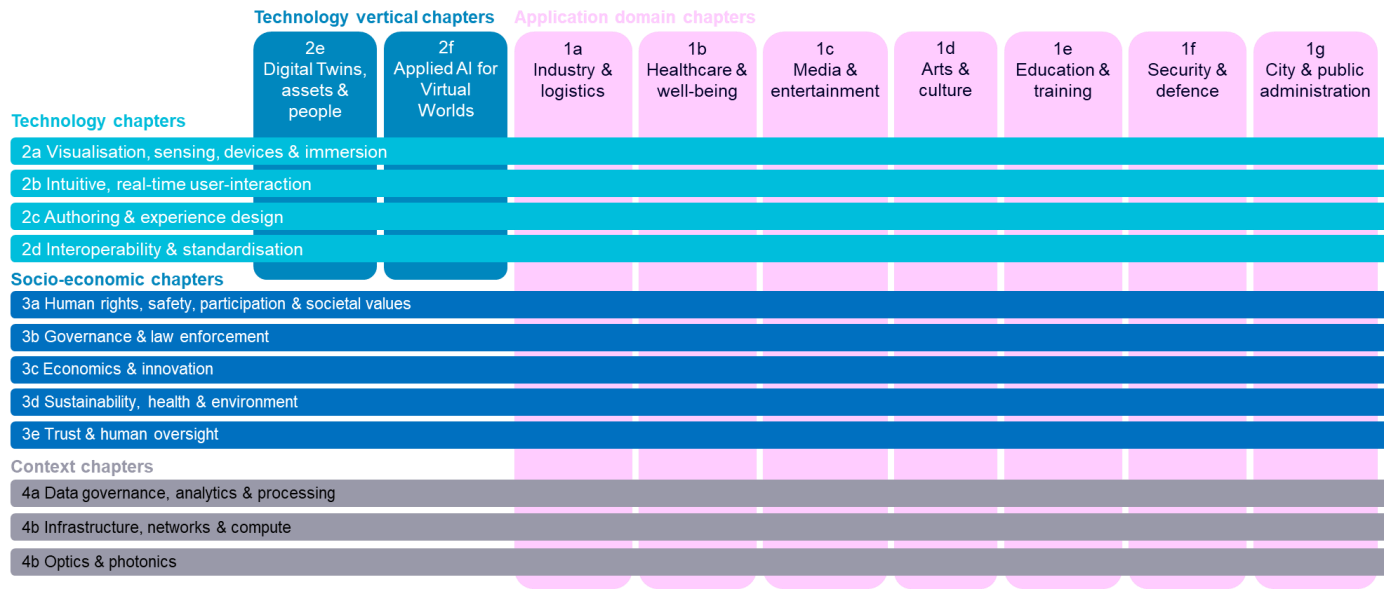
Applications and opportunities in 7 key sectors
The development and expansion of Virtual Worlds (VW) involve a diverse array of stakeholders, including technology companies, content creators, and end-users. The key players in the VW ecosystem range from major corporations to independent developers, user communities, research institutes and public services. In Chapter 1 we address seven domains and identify key use cases to drive associated technology development priorities:
- a. Industry and logistics
- b. Healthcare and well-being
- c. Media and entertainment
- d. Arts and culture
- e. Education and training
- f. Security and defence
- g. Cities and public administration
We explore the roles and interests of various stakeholders per use case, highlighting the collaborative efforts required to build and sustain value adding VW. By mapping out the landscape of key players, we gain insights into the dynamics shaping VW' growth and evolution.
Technical outlook and challenges
The identified VW use cases, present several technical challenges that must be addressed to realise their full potential. Chapter 2 examines these challenges, grouped into the following categories:
- a. Visualisation, sensing, devices and immersion
- b. Real-time user interaction
- c. Authoring and experience design
- d. Standardisation and interoperability
- e. Digital Twins, assets, and people
- f. Applied Artificial Intelligence for Virtual Worlds
By identifying and analysing the research topics, we provide a comprehensive understanding of the research gaps in the path towards a European competitive positioning for VW.
Socio-economic outlook and challenges
VW have far-reaching implications for society and the economy, influencing how we live, work, and interact. Chapter 3 delves into the potential societal and economic impacts of VW, from changes in social behaviour and communication to new business models and economic opportunities. We discuss both the positive and negative aspects of these implications, considering issues such as digital divide, privacy, health, legal and ethical concerns. By examining the broader consequences of VW, we aim to provide a balanced perspective on their transformative potential and the needs for European autonomy in specific technologies. The following sections are presented:
- a. Human rights, safety, participation and societal values
- b. Governance and law enforcement
- c. Economics and innovation
- d. Sustainability, health and environment
- e. Trust and human oversight
The European research and innovation context
The European Commission is advancing a comprehensive strategy to position Europe as a leader in the development and governance of VW and Web 4.0. These technologies represent the next stage in digital transformation, merging physical and digital realities to create immersive, intelligent, and interconnected environments with broad societal, economic, and industrial implications.
The strategy, adopted in July 2023, aims to ensure these emerging technologies develop in alignment with EU values, supporting a human-centric, open, secure, and fair digital environment. Structured around the pillars of the Digital Decade policy program, the initiative addresses skills, infrastructure, innovation ecosystems, and global governance. It commits to supporting citizens with a dedicated guidance toolbox and talent development programs, including actions to boost female participation and digital literacy. To bolster the industrial ecosystem, the Commission is backing a candidate Horizon Europe Partnership on VW and promoting regulatory experimentation through sandboxes. Public sector applications are already underway via major initiatives such as Destination Earth, Local Digital Twins, and the European Virtual Human Twin. These efforts are complemented by global standardisation and governance engagement to ensure interoperability and openness.
Under Horizon Europe, concrete actions are already being taken to translate the strategy into research and innovation. Research on Extended reality technologies and applications have been funded throughout the first part of HEurope (2021-2024). Two key topics under the 2025 Work Program illustrate the depth and direction of these initiatives. First, the GenAI4EU Innovation Action supports the use of generative AI for enhancing the performance, personalisation, and inclusiveness of VW. It aims to support the creation of safe, immersive environments, intelligent digital assistants, and human-centred interfaces, with a strong focus on social sciences and humanities to ensure societal impact. Second, the Research and Innovation Action on Core Technologies for Virtual Worlds focuses on advancing multimodal interaction through optics and photonics. The call encourages the development of immersive systems incorporating touch, vision, haptics, and olfactory feedback, and prioritizes high performance microdisplays, waveguides, and sensor integration. It emphasizes the importance of human perception, interoperability, and EU values such as privacy, diversity, and accessibility.
These research actions are anchored in co-programmed European Partnerships, notably in AI, Data and Robotics (ADRA), Big Data Value Association (BDVA), Virtual Worlds, and Photonics. They aim to bridge technological excellence with ethical responsibility and real-world applications, including health, education, cultural heritage, and urban planning.
Overall, the EU’s initiatives on VW are designed not only to develop innovative technologies but also to shape the regulatory and social landscape that surrounds them. Authorities and academic institutions are encouraged to engage with these initiatives, contribute expertise, and collaborate across disciplines and sectors to co-create an inclusive, secure, and globally competitive European digital future. The proposed Strategic Research and Innovation Agenda (SRIA) aims to function as continuation and built on the ongoing of activities of the European Commission, while targeting to leverage key developments from associated partnerships as described in Chapter 4.
A scientific roadmap for technological developments
This document aims to present a scientific roadmap that outlines a strategic path for the responsible, inclusive, and innovative development of VW that would enable Europe to tackle real world challenges. By systematically addressing technological, ethical, social, and governance challenges across these horizons, Europe can ensure its leadership in shaping sustainable, equitable, and secure digital future.
VW represent transformative digital environments where immersive technologies, advanced AI systems, and interconnected data ecosystems converge. This roadmap synthesizes key technological developments outlined in recent research agendas and policy documents, categorizing them into short term, mid-term, and long-term horizons. As the technologies described in Section 2, such as visualization, sensing, devices, and immersion, evolve and mature along this strategic timeline, they will underpin the realization of the diverse application use cases as described in Section 1. These advancements are critical for enhancing the fidelity and interactivity of virtual environments, making them more suitable for real-world problem-solving across various sectors. For instance, improvements in XR hardware and real-time user interaction will directly enable more effective training simulations in healthcare and defence, as well as richer cultural and entertainment experiences. The continued progress in these foundational technologies, across short-term, mid-term, and long-term horizons, is essential for unlocking the full potential of VW in addressing complex societal and economic challenges.
While certain technologies might mature faster than others, it’s in the convergence and synergies between them that the vision of VW of the future will fully deploy. The proposed clustering of these horizons represents a preliminary estimation, grounded in the current technical maturity of the various requisite technologies, alongside their observed evolution in recent years. The horizons presented below represent the time needed to harvest the full potential of the developments as they have diverse Technology Readiness Levels today and it is important to start investing and investigating from early stage in all the three horizons.
Short-term technological developments (3-5 Years)
In the short term, real-time user interaction and immersion will be enhanced through the development of ergonomic extended reality XR hardware and adaptive systems that mitigate motion sickness and physical strain. To promote inclusivity and creativity, accessible authoring environments such as low code and no-code platforms are being introduced alongside comprehensive accessibility standards.
Concurrently, AI-driven content creation is advancing with the implementation of generative models that streamline immersive content generation and AI-assisted moderation tools to govern these environments. Addressing regulatory and ethical obligations, adaptive governance frameworks aligned with the GDPR, AI Act, and Data Act are being implemented, including certification mechanisms to ensure robust data governance and protection practices. Efforts are underway to finalize and adopt interoperable standards for DT and VW ecosystems to facilitate cross-platform experiences and seamless asset exchange.
Mid-term technological developments (5-7 Years)
Looking to the mid-term horizon, development focuses on integrating advanced XR hardware with improved optical systems and rich sensory experiences, as well as deploying scalable cloud-edge infrastructure to support immersive content delivery. Human-centric AI interaction is also gaining traction, marked by the creation of multimodal interaction frameworks and context-aware virtual avatars capable of adaptive responses. Parallel to this, work is progressing on transparent and ethical AI frameworks, including the development of explainable AI tailored for immersive environments and the adoption of ethics-by-design approaches to support responsible content generation.
Long-term technological developments (7-10 Years)
Over the long term, research will explore next-generation immersive technologies such as neuromorphic computing and bio-integrated sensors, alongside brain-computer interfaces (BCIs) for seamless integration of neural input, smart haptics and device-free interaction. Future virtual environments are envisioned to be adaptive and context-aware, with AI models capable of self-evolution, leveraging edge computing and DT ecosystems. Environmental and economic sustainability will be prioritized through circular economy models for immersive hardware and frameworks that link sustainability performance to funding and resource management.
Socio-economic impact of Virtual Worlds
Expected economic impact of Virtual Worlds in Europe
VW are expected to significantly reshape Europe's economic landscape, offering substantial growth and job creation opportunities across various sectors. The global market for VW is projected to experience substantial growth, expanding from an estimated €27 billion in 2022 to over €800 billion by 20302. The European Commission is ready to play a pivotal role in accelerating the development and widespread adoption of VW across member states. By fostering a robust European Web 4.0 industrial ecosystem and investing in critical infrastructure and skills, the Commission can significantly contribute to the increased GDP of member states through new economic opportunities and enhanced productivity across various sectors.
Job creation
Beyond GDP growth, the proliferation of VW is set to generate significant employment opportunities. Forecasts indicate the creation of approximately 860,000 new jobs related to XR technologies in Europe by 2025. These new roles will span various fields, including virtual world architecture, content creation, and specialized technical development, necessitating substantial investment in reskilling and upskilling initiatives for the existing workforce.
Sectoral impact and opportunities
VW are poised to revolutionize numerous sectors, driving efficiency, innovation, and new service models:
- Industry and logistics: VW applications will enable intelligent, resilient, and connected operations, fostering more efficient, cost-effective, and sustainable digital processes. Industries can leverage virtual environments for product design, development, simulation, testing, inventory optimization, and immersive staff training, reducing risks and accelerating innovation cycles.
- Healthcare and well-being: VW will facilitate advancements in health services, supporting clinical decisions and personalized treatments through technologies like the European Virtual Human Twin.
- Education and training: Immersive virtual environments offer more engaging and effective learning experiences, particularly for developing soft skills and foreign language proficiency.
- Public services: VW can enhance public services, with initiatives like "CitiVerse" aimed at improving urban planning and management, and the development of Local Digital Twins.
- Arts and culture: VW will enable immersive cultural experiences, allowing access to virtual museums and galleries, thereby broadening reach and engagement.
- Agriculture: Virtual solutions can provide remote assistance for machinery operation and more precise animal treatment, boosting productivity and safety.
A more detailed presentation of the socioeconomic impact of VW will be the exclusive focus of Chapter 3. This dedicated section will thoroughly explore the economic opportunities, societal shifts, and potential challenges associated with their widespread adoption.
Provide Feedback
Share your thoughts on Introduction – Virtual Worlds, solving real world problems. Your feedback helps shape Europe's Virtual Worlds research priorities.